


Dial caliper
In many workshops, inspection rooms, and maintenance departments, quick dimensional checks still rely on tools that are easy to read, dependable in daily use, and familiar to the operator. Dial caliper models continue to serve that role well, especially when users want a mechanical reading system without depending on batteries or electronic displays.
For routine measurement of outside dimensions, inside dimensions, step features, and depth, dial calipers remain a practical choice. They fit naturally into machining, fabrication, maintenance, training, and general quality control workflows where repeatability, simple handling, and clear visual indication matter more than added electronic functions.
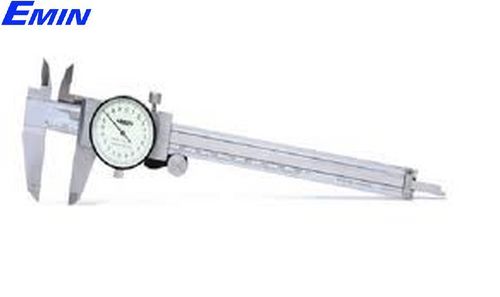
Why dial calipers are still widely used
A dial caliper offers a useful balance between traditional vernier reading and electronic convenience. Instead of reading only from a scale, the user gets a pointer-based display that makes small changes easier to notice during repeated measurements. In production environments, this can help operators compare parts quickly and spot variation at a glance.
Another reason for their continued popularity is simplicity. There are no batteries to replace, no screen visibility concerns, and no electronic components to manage during basic measurement tasks. For many users, that makes dial calipers a reliable everyday tool alongside digital caliper models for applications that require direct electronic readout.
Typical measurement tasks and working environments
Dial calipers are commonly used for checking shaft diameters, plate thickness, hole sizes, groove dimensions, and overall part dimensions during setup or in-process inspection. Their structure supports multiple measurement modes in one instrument, which is why they remain useful in machine shops, assembly lines, technical schools, and maintenance teams.
They are also suitable when the job requires frequent manual checks rather than formal lab-style measurement. A technician may use a dial caliper to verify whether a machined part is staying within tolerance before deciding if a more specialized instrument is needed. For general shop-floor work, that speed and flexibility is often more important than adding unnecessary complexity.
How to choose the right model
The first point to consider is measuring range. For many standard tasks, a 0-150 mm or 0-6 inch model is enough, as seen in several products in this category. This range is widely used because it covers common mechanical components while keeping the tool compact and easy to handle.
The second point is resolution and graduation. Some applications are well served by 0.02 mm or 0.1 mm readings, while others require finer indication such as 0.01 mm or 0.001 inch. If your work involves frequent comparison of small dimensional changes, a finer graduation can improve readability and control during repetitive checks.
It is also worth looking at construction details that affect daily use, such as jaw size, depth rod style, and whether a friction wheel is included. For users comparing mechanical formats, Vernier Calipers may appeal to those who prefer a purely scale-based reading method, while dial models offer faster visual interpretation for many operators.
Examples from leading manufacturers in this category
Mahr is one of the key names represented here, with dial calipers in common 0-150 mm and 0-6 inch formats. Examples such as the Mahr 4107005KAL and Mahr 4107107KAL show the typical specification profile many buyers look for: standard workshop measuring range, DIN 862 reference on selected models, and clear graduation choices for different inspection needs.
For users who need documented calibration, the category also includes versions such as the Mahr 4107900KAL and 4107900DKS, which are supplied with calibration certificates. This is relevant for companies that need stronger traceability in quality procedures, internal audits, or controlled production environments.
MOORE & WRIGHT appears in this category with practical options such as the CDP150M and CDP006E plastic dial calipers. These products are suitable examples of straightforward measuring tools for general use, training, or lighter-duty tasks. The MW200-SET2 set also shows how a dial caliper can be part of a wider measurement kit together with a micrometer and engineers' rule.
Dial caliper vs other caliper types
Each caliper format has a different advantage. A dial caliper is often chosen when users want a mechanical display that is easier to scan than a vernier scale and less dependent on electronics than a digital model. This makes it attractive for repetitive manual inspection and for users who prefer tactile, direct operation.
Digital calipers are often preferred when inch-metric conversion, data readability, or additional electronic functions are important. Vernier calipers, on the other hand, are valued for their simple design and traditional scale reading. If the task is more specialized, such as measuring particular external geometries, a dedicated diameter measurement caliper may be more appropriate than a general-purpose dial model.
What matters in daily use and maintenance
Good measuring performance depends not only on the specification sheet but also on how the tool is used. Clean measuring faces, smooth jaw movement, correct zero checking, and careful handling all affect consistency. Even a well-made dial caliper should be protected from impact, dirt buildup, and improper storage if it is expected to remain stable over time.
Calibration and periodic verification are also important, especially in professional production settings. Models supplied with manufacturer or DAkkS-related certification may be more suitable where documentation is part of the purchasing requirement. For routine workshop use, regular inspection and proper cleaning usually go a long way toward keeping the instrument dependable.
Who should consider a dial caliper
This category is relevant for buyers who need a dependable general-purpose measuring tool without moving fully to electronic instruments. It suits mechanical workshops, maintenance teams, vocational training centers, toolrooms, and manufacturers that perform regular manual dimensional checks on medium-size parts.
It can also be a good fit for companies standardizing multiple tool types across departments. A dial caliper works well as an everyday inspection instrument, while more advanced or specialized tools can be added only where the application requires them. That approach keeps the measuring setup practical and aligned with real production needs.
Finding the right fit for your measurement workflow
The best choice depends on how the instrument will be used: quick shop-floor checking, documented inspection, training, or inclusion in a broader measurement set. Range, reading resolution, certification needs, and construction details should all be matched to the actual task rather than selected on price alone.
Within this category, buyers can compare established options from Mahr and MOORE & WRIGHT across common 150 mm and 6 inch formats, including standard workshop models and certificate-supplied versions. A well-chosen dial caliper remains a practical, efficient tool for day-to-day dimensional measurement in many industrial settings.
-
-
-
-
-
-
-
-
-
-
-
-
-
-
-
-
-
-
-
-
-
-
-
-