


Texture Analyzer
When product feel, firmness, consistency, and structural response need to be measured in a repeatable way, a texture analyzer becomes an essential lab and quality-control instrument. In food, cosmetics, pharmaceuticals, and material testing workflows, these systems help teams translate subjective texture perception into quantifiable mechanical data that can be compared across batches, formulations, and development stages.
This category brings together Texture Analyzer solutions used for compression and traction testing, with configurations suited to different force ranges and sample types. It is especially relevant for laboratories that need controlled movement, stable force measurement, method repeatability, and the flexibility to work with multiple probes and fixtures.
Where texture analyzers are used
Texture testing is widely used whenever product structure affects performance, processing, or user experience. In food applications, this may involve evaluating hardness, adhesiveness, penetration behavior, or cycle-based texture response. In cosmetics and personal care, texture data can support consistency checks for creams, gels, and semi-solid products. In pharmaceutical and material-related environments, similar principles are applied to assess deformation, resistance, and handling characteristics.
Compared with purely visual inspection or sensory evaluation alone, a texture analyzer provides a more controlled and traceable way to evaluate how a sample behaves under force. This helps teams standardize internal methods, compare production lots, and document test conditions more reliably.
Typical capabilities in this category
The instruments highlighted here are designed for compression and traction testing, with touchscreen operation and compatibility with a broad range of probes and fixtures. That flexibility matters because texture testing rarely relies on one universal setup; the geometry of the measuring system strongly influences the test result and must match the sample and method.
Several models in this category also support operating modes such as relaxation, TPA cycle, and penetrometry-style testing. Integrated temperature indication via PT100, USB and RS232 communication, and method storage can also be important for labs that need better process control, operator traceability, and easier data export.
Representative systems from Lamy Rheology
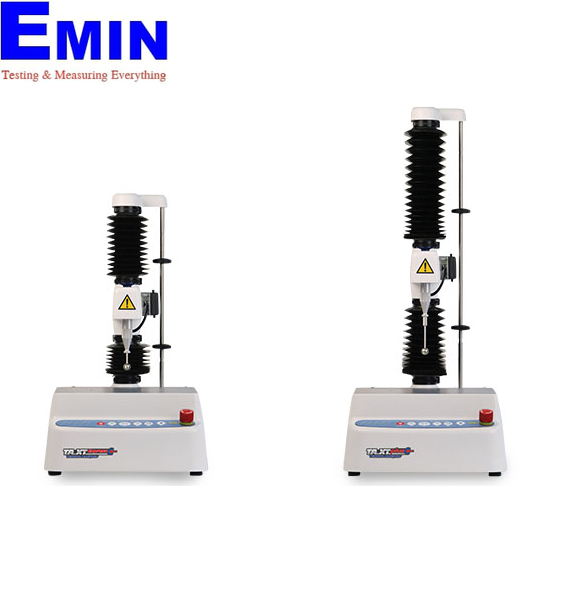
A major reference in this category is Lamy Rheology, with the TX-700 and TX-900 series covering a practical range of testing needs. Both series are built around the same general measurement approach, but they differ in vertical travel, which can influence sample accommodation and fixture selection depending on the application.
For example, the TX-700 Texture Analyzer (10N) is suitable for low-force applications where fine resolution is important, while the TX-700 range also extends through 20N, 50N, 100N, 250N, and 500N configurations. For applications requiring greater movement height, the TX-900 family includes versions such as the TX-900 50N, 100N, 250N, and 500N, offering the same core touchscreen workflow with a taller motion range.
The choice between these models is not only about maximum load. It also depends on specimen geometry, expected deformation distance, fixture arrangement, and whether the lab needs more compact equipment or a larger working envelope.
How to choose the right force range
One of the most important selection criteria is the load cell capacity. A force range that is too high can reduce useful sensitivity for delicate samples, while a range that is too low may limit the instrument when testing firmer products or when using larger probes. In practice, the best choice is usually a sensor that comfortably covers expected peak forces without operating too close to its maximum on every test.
Lower-force versions such as 10N or 20N are often more appropriate for soft or highly deformable samples. Mid-range options like 50N and 100N can suit a broad variety of routine texture measurements, while 250N and 500N models are more relevant when samples are firmer, fixtures are larger, or test methods involve higher resistance during compression or traction.
If your evaluation process includes other force-related instrumentation, related categories such as load cell transmitters and weighing indicators can also be useful for broader measurement system planning.
Why probes, fixtures, and software matter
A texture analyzer is only as useful as the test setup built around it. Probe type, contact shape, support fixture, test speed, travel distance, and endpoint logic all influence the resulting curve and the parameters you can derive from it. That is why compatibility with multiple accessories is such an important part of this category.
The systems listed here support different probes and fixtures, and selected models can work with software for external control and data handling. For labs that manage repeated product qualification methods, this can simplify method storage, reduce operator variability, and improve consistency when the same test must be reproduced across time or sites.
Peripheral tools may also support smoother operation and documentation. If you are building out a more complete testing workstation, it may be helpful to review available peripheral devices that complement the instrument environment.
TX-700 vs. TX-900: practical comparison
The TX-700 and TX-900 series share many functional traits, including 7-inch touchscreen control, multiple operating modes, data export options, and support for interchangeable measurement setups. The main practical difference visible in the listed models is motion height: TX-700 systems provide a shorter vertical range than TX-900 systems.
That distinction can be significant in real applications. A taller motion range may help when working with larger samples, taller fixtures, or test methods requiring greater displacement before contact, compression, or pull-off completion. A more compact system may still be the better fit where bench space is limited and test geometry is less demanding.
From a purchasing perspective, it is often best to define the sample dimensions, expected force range, and preferred test methods first. Once those parameters are clear, choosing between the two series becomes much more straightforward.
What to review before ordering
Before selecting a texture analyzer, it is worth documenting a few practical points: sample type, expected force range, typical test travel, need for temperature indication, number of operators, data export requirements, and whether methods need to be locked for controlled routine use. These details often have more impact on long-term usability than a simple comparison of maximum force values.
It is also useful to think about future test expansion. A lab may begin with one core texture method and later add different probes, other fixtures, or additional product formats. Choosing a system with room for method development can help avoid early limitations as testing requirements evolve.
Supporting consistent texture measurement
For development labs and quality teams, texture analysis sits at the intersection of force measurement and product performance evaluation. A well-matched instrument can support repeatable testing, clearer product comparisons, and more reliable documentation of how samples behave under defined mechanical conditions.
Within this category, the available systems from Lamy Rheology cover a useful span from low-force testing up to higher-capacity configurations, with TX-700 and TX-900 options suited to different sample and travel requirements. If you are comparing models, start with the force range, movement height, and accessory needs that align with your actual test method; that approach usually leads to a more practical and durable selection.
-
-
-
-
-
-
-
-
-
-
-
-
-
-
-
-
-
-
-
-
-
-
-
-