


Spring tester
Reliable spring performance is critical in automotive parts, industrial assemblies, consumer products, and quality control laboratories. When force, deflection, and repeatability need to be verified with confidence, a Spring tester helps quantify how a spring behaves under compression, tension, or side load conditions instead of relying on visual inspection alone.
This category brings together spring testing instruments used for production checks, incoming inspection, and more advanced evaluation of spring characteristics. Depending on the application, users may need a compact bench unit for small springs, a higher-capacity system for suspension components, or an automatic tester designed for sorting and repetitive throughput.
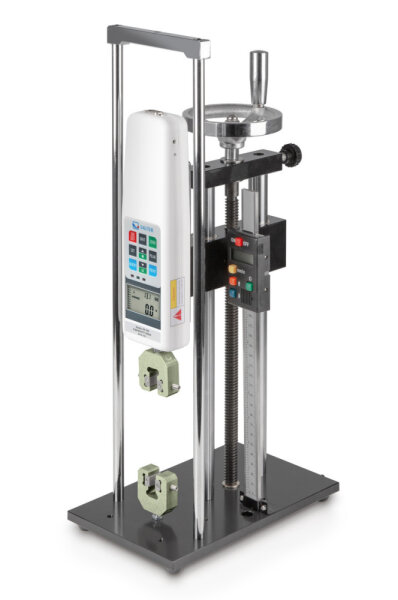
Where spring testers are used
Spring testing is relevant anywhere a component must deliver a predictable force at a given displacement. Typical use cases include checking compression springs in general manufacturing, validating tension springs in assembly processes, and evaluating larger suspension or leaf springs used in transport and heavy equipment applications.
In practice, the right tester supports more than a pass/fail result. It also helps teams monitor production consistency, compare batches, investigate nonconforming parts, and document measurement results for internal quality procedures. For applications that involve broader force measurement chains, related devices such as load cell transmitters may also be relevant in the overall setup.
Common test methods and measurement points
A spring tester is typically selected based on the type of spring and the way it will be evaluated. Many applications focus on compression testing, where force is measured against a defined displacement or free length. Others require tension testing, especially for extension springs, while some specialized systems also address side force behavior in suspension-related components.
Key measurement considerations usually include maximum load, resolution, length measurement capability, travel or stroke, and control of test speed. These parameters affect whether a tester is suitable for delicate small springs, medium-duty quality checks, or large industrial and automotive springs where both capacity and mechanical rigidity matter.
Product examples across different testing needs
For general-purpose spring evaluation at lower force ranges, the SAUTER portfolio includes solutions such as the SAUTER SD 100N100 Spring tester, which is suited to relatively low-force testing with fine readout resolution. Equipment in this class can be useful for smaller components, routine inspections, and applications where straightforward operation and basic statistical or peak functions are sufficient.
At the other end of the range, JISC offers systems aimed at more demanding spring tests. Models such as the JISC SFT-1KN and JISC SFT-5KN are intended for suspension spring and side force spring testing, while the JISC SST-20kN and JISC SST-50KN address higher-capacity compression-only work. For leaf spring applications, the JISC LEAF-5000 provides a dedicated solution tailored to that type of component rather than a one-size-fits-all bench tester.
Manual, semi-automatic, and automatic testing approaches
Not every production environment has the same throughput requirement. In laboratories, maintenance departments, or low-volume inspection stations, a conventional bench spring tester may be the most practical choice. These systems are often easier to integrate into routine measurement work and are suitable when operators need flexibility across different sample types.
In higher-volume manufacturing, automatic spring testing can help reduce manual handling and improve repeatability between operators. Examples in this category include the JISC ACE-F100N, ACE-F500N, ACE-F1KN, ACE-100N, and ACE-1KN series, all designed for repetitive testing with sorting-oriented workflows. If the goal is to speed up screening while maintaining defined load and length criteria, this kind of equipment may be more suitable than a basic bench model.
How to choose the right spring tester
The starting point is the spring itself: type, size, expected load range, and required measurement method. A tester that is oversized may sacrifice useful resolution for small parts, while an undersized system may not provide enough capacity or mechanical margin for heavier springs. For that reason, buyers usually compare the expected force range, test stroke, resolution, and accuracy against the actual inspection requirement rather than looking at maximum capacity alone.
It is also important to consider the production environment. If operators need fast repetitive checks, automatic or programmable models are often easier to justify. If the task involves setup changes, engineering evaluation, or mixed sample sizes, a more flexible standalone tester may be the better fit. In broader force and deformation analysis, supporting tools such as strain meters or strain gauges can complement spring-related testing where structural response is part of the analysis.
What to evaluate beyond load capacity
Load capacity is important, but it should not be the only filter. Buyers should also look at resolution and accuracy, because these directly affect how precisely the system can detect changes in force and displacement. For acceptance testing, process control, and comparison between production lots, measurement quality is often more valuable than simply having a higher maximum range.
Other practical factors include travel length, test speed control, available units, overload protection, and whether the machine supports tension, compression, or both. For some users, data handling functions, peak capture, or limit setting will also influence the decision, especially when test records need to be standardized across multiple operators or production shifts.
Suitable brands and solution range
This category highlights established names used in force measurement and spring testing, including JISC and SAUTER, while also providing access to broader brand options such as Aikoh and Cometech within the wider measurement ecosystem. Brand choice often depends on whether the priority is compact bench testing, specialized suspension spring evaluation, or automated inspection for repetitive production tasks.
Rather than focusing only on model names, it is usually more effective to match the application to the testing method first. Once the test type, force range, and throughput target are clear, narrowing the shortlist becomes much easier and helps avoid selecting a machine that is technically capable but not operationally efficient for the real workflow.
Finding a practical fit for your workflow
A well-matched spring tester supports consistent quality checks, clearer acceptance criteria, and more reliable force-displacement verification across production or laboratory tasks. From compact low-force systems to high-capacity suspension and leaf spring testers, the category covers a range of use cases without forcing every application into the same testing approach.
If you are comparing options, start with the spring type, required load range, and expected testing volume. That usually provides the fastest path to selecting equipment that delivers useful measurement performance, appropriate automation level, and a better fit for day-to-day inspection work.
-
-
-
-
-
-
-
-
-
-
-
-
-
-
-
-
-
-
-
-
-
-
-
-