


Force gauges for humans
Reliable muscle and grip strength data is important in rehabilitation, sports science, occupational health, and clinical assessment. When measurements need to be repeatable, easy to document, and suitable for day-to-day use, Force gauges for humans provide a practical way to quantify human-applied force instead of relying on subjective evaluation alone.
This category brings together instruments designed for human strength testing, including hand grip dynamometers, myometers, and dedicated force sensors for body-related measurements. These tools are used where consistent results matter, whether for tracking recovery progress, comparing left and right side performance, or recording force output over time.
Where human force gauges are typically used
Human force measurement is common in environments where physical capability must be assessed objectively. Typical use cases include physiotherapy clinics, rehabilitation centers, sports performance labs, ergonomic studies, research programs, and workplace fitness evaluations.
Compared with general-purpose force measurement devices, instruments in this category are selected for contact with the human body, practical handling, and workflows that support repeated testing. In many cases, the goal is not only to capture peak force, but also to compare results between sessions, operators, or patient groups.
Main device types in this category
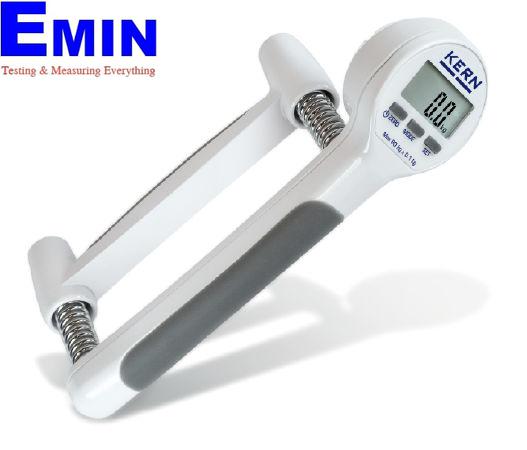
A large part of this range is focused on grip strength measurement. Hand grip dynamometers are widely used for fast screening and routine assessment because they are simple to operate and suitable for repeated measurements. Models such as the KERN MAP 130K1 Hand grip dynamometer, KERN MAP 80K1, and KERN MAP 80K1S illustrate this type of solution, with selectable spring sets and digital readout for clear result interpretation.
For broader muscle testing beyond the hand, a dedicated myometer may be more appropriate. The Mecmesin Myometer Muscle Strength Tester is an example of a system intended for structured muscle strength assessment, combining digital indication, high data capture capability, and accessories for practical positioning during tests.
This category also includes body-contact force sensors intended for specific measurement geometry. For example, the SAUTER AC 45 Concave Force Sensor is shaped for arm and leg measurement, while the SAUTER AC 46 Flat Square-Shaped Sensor is suited to lateral power sensing of areas such as the back, chest, or arm.
How to choose the right instrument
The first decision point is the measurement task. If the application is straightforward hand grip testing, a compact dynamometer is often the best fit. If the requirement involves broader muscle groups, controlled positioning, or more detailed test workflows, a myometer or a force gauge used with application-specific sensors may be more suitable.
Force range is also important. The selected device should cover expected human output without operating too close to full scale in normal use. Readability, display visibility, and unit selection can matter in clinical and lab settings, especially when multiple operators need to read and record values quickly.
Another practical factor is how the instrument will be used over time. Battery operating time, portability, included accessories, and ease of setup all influence daily efficiency. For more advanced data handling, users may also need output functions or software support for logging and reviewing measurement results.
Why sensor shape and test setup matter
In human force testing, contact geometry has a direct effect on consistency. A sensor designed for the hand will not always be suitable for the forearm, ankle, chest, or back. That is why application-specific accessories and sensor forms are valuable: they help standardize body position and force transfer during the test.
The SAUTER AC 45 Concave Force Sensor is intended to improve contact when measuring arms and legs, while the SAUTER AC 46 Flat Square-Shaped Sensor supports lateral force applications on broader body areas. Choosing the right interface can help reduce positioning variability and improve the comparability of readings between operators and sessions.
Data quality and repeatability in clinical and performance testing
A useful force measurement result is not only about the displayed number. In rehabilitation and performance tracking, repeatability is often more important than a single isolated reading. Consistent testing protocol, stable subject positioning, and clear instructions are essential for producing data that can support decisions.
Digital instruments can support this process by improving readability and reducing interpretation errors. Some systems also offer output or software-based workflows that make it easier to store values, compare sessions, and integrate testing into broader documentation processes. Where measurement data must be transferred or conditioned for a wider setup, related categories such as load cell transmitters may also be relevant.
Typical product examples from leading manufacturers
KERN is well known for practical digital measuring equipment, and its MAP series hand grip dynamometers are a good match for routine grip strength testing where portability and clear readout are priorities. Different capacity options and spring sets allow these models to be adapted to different user groups and measurement ranges.
For structured muscle force assessment, Mecmesin provides a more system-oriented approach through its Myometer Muscle Strength Tester. SAUTER complements the category with dedicated force sensors that help adapt measurement setups to specific body regions. Together, these examples show that human force testing is not a single-device application, but a combination of instrument, sensor, and test method.
Related equipment in the force measurement workflow
Depending on the installation or data collection requirement, human force gauges may be part of a broader measurement chain. In some applications, users also work with signal conditioning, indicators, or external accessories to suit their workflow, especially in lab environments or custom test benches.
If you are building a more complete measurement setup, it can be useful to review related product groups such as weighing indicators for result display or peripheral devices that support integration and operation around the main instrument.
Choosing with confidence
The right solution depends on who is being tested, which muscle group is involved, and how the results will be used. A grip dynamometer may be ideal for fast screening, while a myometer or application-specific sensor setup may be better for controlled clinical or research measurements.
By focusing on force range, contact geometry, repeatability, and data handling needs, it becomes easier to select equipment that fits real working conditions. This category is intended to support that process with practical instruments for measuring human strength in a more objective and consistent way.
-
-
-
-
-
-
-
-
-
-
-
-
-
-
-
-
-
-
-
-
-
-
-
-