


Force gauge stand
Consistent force testing depends on more than the gauge itself. In many push and pull measurement tasks, repeatability improves significantly when the force gauge is mounted on a dedicated stand that controls alignment, travel, and test speed. For laboratories, quality departments, and production environments, a force gauge stand helps reduce operator influence and makes results easier to compare across batches, products, or test methods.
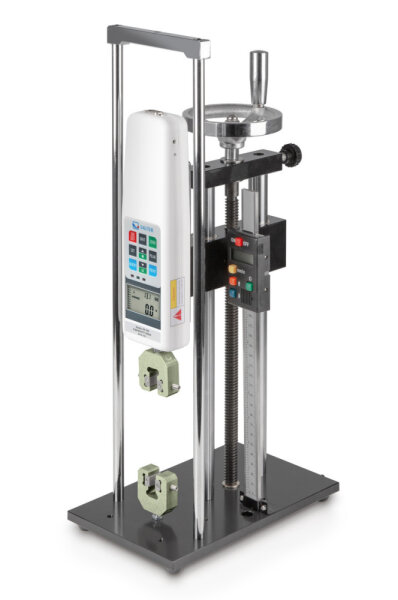
This category includes stands designed to support force gauges in manual and motorized test setups. Depending on the application, users may need a vertical or horizontal layout, a handwheel-driven mechanism for simple routine checks, or an electronic stand for more controlled movement and higher test consistency.
Why a force gauge stand matters in practical testing
Handheld force measurements are useful for quick checks, but they can introduce variation in test angle, movement speed, and applied force direction. A stand creates a more stable test arrangement, which is especially important when evaluating compression, tension, insertion force, peel behavior, switch actuation, or component durability.
In routine quality control, the value of a stand is often tied to repeatable test conditions. Keeping the gauge and sample aligned helps improve measurement consistency, while controlled travel makes it easier to compare results over time. This is particularly relevant when multiple operators perform the same test or when results need to be documented for internal quality procedures.
Manual and motorized stand options
One of the main selection points is whether the test stand should be operated manually or by motor drive. Manual stands are typically chosen for straightforward test routines, operator-controlled movement, and environments where flexibility matters more than automation. Models such as the PCE FTS50 Test Stand for PCE-FTS50 Force Gauge and the Alluris FMT-220 series illustrate this type of setup, using a handwheel to move the gauge through the test stroke.
Motorized systems are more suitable when testing requires defined feed rates, better cycle-to-cycle consistency, or reduced operator dependency. Examples in this category include the PCE VTS 50 Test Stand, PCE HTS 50 Electronic Horizontal Test Stand, and the Alluris FMT-230 series. These solutions are often preferred when the test method benefits from controlled speed and more precise positioning over the travel path.
Vertical and horizontal test configurations
The physical orientation of the stand should match the real testing task. Vertical test stands are common for compression and pull tests where the sample is loaded from above or below. They are often used for packaging components, springs, connectors, foam materials, or general product resistance checks.
Horizontal stands are useful when the fixture arrangement, product geometry, or operator access makes side-loading more practical. The PCE HTS 50 is a good example of a horizontal electronic configuration within this category. Choosing the right orientation can simplify sample handling and reduce unwanted side loads that may affect the measurement.
What to consider when selecting a stand
The first technical checkpoint is force capacity. The stand should comfortably support the expected test load and remain compatible with the force gauge being used. In the products shown here, capacities range from lighter-duty applications around 500 N up to heavier setups such as the PCE MTS500, which is intended for substantially higher test forces.
The second factor is stroke or travel. A short travel stand may be sufficient for button, switch, or connector testing, while larger samples or longer displacement tests need more vertical movement. Speed control is also important for motorized stands, especially when the test standard or internal procedure requires a defined movement rate.
Users should also review fixture mounting, sample space, and gauge compatibility. Some stands are designed around a specific gauge family, while others fit broader mounting arrangements. If the test setup also involves signal processing or system integration, related products such as a load cell transmitter or a weighing indicator may become relevant in the wider measurement chain.
Examples of force gauge stands in this category
PCE is represented here with both manual and motorized stand options. The PCE VTS 50 offers a vertical motorized format with controlled travel and speed adjustment, while the PCE HTS 50 provides a similar concept in a horizontal arrangement. For users who need a simpler bench-mounted solution, the PCE FTS50 and PCE MTS500 cover different force ranges and testing requirements.
Alluris expands the category with handwheel-driven and motorized vertical test benches. The FMT-220 series addresses manual push and pull tasks, while the FMT-230 series is suited to applications that benefit from motor drive, defined speed settings, and more structured test execution. The available versions also show how capacity and stroke length can be matched to the sample and test method rather than using a one-size-fits-all approach.
Typical applications across quality control and product testing
A force gauge stand is commonly used wherever push or pull force must be measured under controlled conditions. This includes incoming inspection, production checks, assembly validation, packaging tests, and comparative product testing. In many cases, the goal is not only to measure peak force, but also to make sure the same test can be repeated with minimal variation.
For example, a manual stand may be sufficient for occasional checks of engagement force or break force, while a motorized bench is often more appropriate for repeated test sequences at a defined speed. When the broader task extends into material deformation or structural monitoring, users may also work alongside strain gauges or dedicated strain meters depending on the measurement principle required.
Choosing the right setup for your workflow
The most suitable stand depends on how often the test is performed, how strictly the procedure must be controlled, and what level of documentation is required. For lower-volume checks, a manual handwheel stand can be practical and cost-effective. For repeated bench testing, verification work, or methods that require defined movement speed, a motorized test stand is usually the better fit.
It is also worth considering the complete test system rather than the stand alone. Force range, travel, orientation, fixture access, and compatibility with the selected gauge all influence final performance. A well-matched setup helps operators work faster, supports more stable measurement conditions, and reduces avoidable variation in daily testing.
Final considerations
This selection of force gauge stands is intended for users who need more controlled push and pull testing than handheld measurement can provide. With manual and motorized options, different travel ranges, and both vertical and horizontal designs, the category supports a wide range of laboratory and industrial force measurement tasks.
When comparing models, focus on the actual test method: required load, sample size, travel distance, speed control, and gauge compatibility. That approach will lead to a more practical and reliable setup than choosing only by capacity or form factor.
-
-
-
-
-
-
-
-
-
-
-
-
-
-
-
-
-
-
-
-
-
-
-
-