


Mobile Thermal Camera CEM
Fast thermal checks no longer require a full-size inspection camera. In maintenance, field service, electrical troubleshooting, and quick building diagnostics, a compact device that connects directly to a phone or tablet can be a practical way to capture temperature patterns, compare hot spots, and document findings on the spot. That is where a Mobile Thermal Camera fits best: portable, easy to deploy, and well suited to technicians who need immediate visual temperature data without carrying larger equipment.
Within this category, buyers will typically look for the right balance of resolution, temperature range, app workflow, connector type, and portability. The products shown here cover several common mobile formats for iOS, Android, and wireless use cases, making this range relevant for both everyday inspection tasks and more advanced thermography workflows.
Where mobile thermal cameras are most useful
Mobile thermal cameras are often chosen when speed and convenience matter more than a larger standalone platform. They are commonly used for preliminary inspection of electrical panels, motors, HVAC components, piping, insulation issues, and equipment that may show abnormal heat distribution before a failure becomes visible.
Because they integrate with smartphones or tablets, they also simplify image capture, reporting, and sharing. For service teams, this makes them useful in field visits, maintenance rounds, acceptance checks, and basic troubleshooting where carrying a dedicated instrument may be less convenient than using a phone-based system.
Typical formats in this category
This category includes several mobile-friendly approaches. Some models connect directly through USB-C, Lightning, or Type-C interfaces, while others use wireless connectivity to pair with a smart device. The choice usually depends on the operating system in use, the preferred handling style, and whether the camera needs to be clipped onto a phone or operated at a short distance.
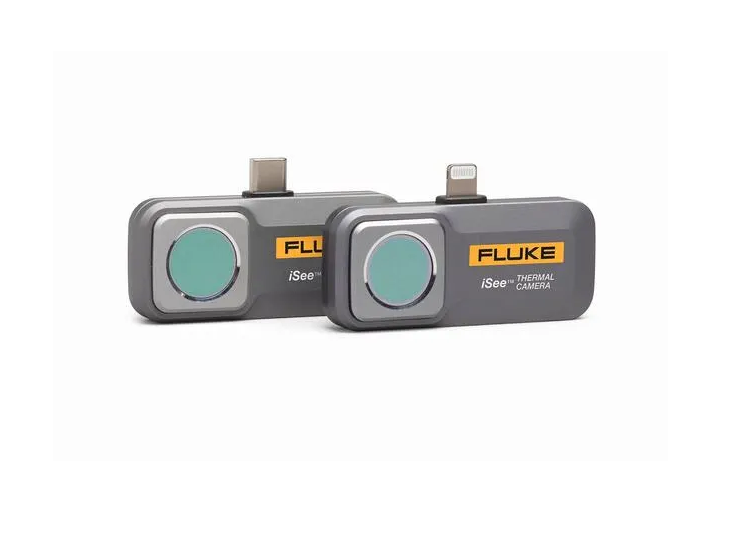
For example, FLUKE TC01 series models such as the FLUKE-TC01A, FLUKE-TC01B, and Fluke-TC01C are designed around direct mobile connection and compact form factor. In the FLIR range, products such as FLIR ONE Edge, FLIR ONE Edge Pro, FLIR ONE PRO-USB-C, and FLIR ONE PRO-iOS illustrate another path, combining mobile app workflows with different connection styles. SEEK Compact and Compact XR versions provide additional options for iOS and Android users who want a pocket-size thermal tool with adjustable focus on selected models.
What to compare before choosing
The first point to review is thermal resolution, because it affects how much detail you can see in the thermal image. In this category, examples range from 80 × 60 and 120 × 90 up to 160 × 120, 206 × 156, and 256 × 192. Higher resolution generally helps when identifying smaller hot spots or reading thermal patterns more clearly, especially on crowded electrical or mechanical assemblies.
The second is temperature range. Some mobile units are focused on routine inspection temperatures, while others extend to higher levels suitable for broader industrial checks. Models listed here span from lower-range building and maintenance applications up to devices capable of measuring several hundred degrees Celsius, which can be relevant for process equipment, electrical diagnostics, or higher-temperature mechanical systems.
Another practical factor is frame rate and workflow. Several FLUKE models in this category offer 25 Hz operation, which can feel smoother during scanning. Other mobile cameras prioritize compactness, app integration, or wireless flexibility. If your team needs frequent image capture, quick annotations, or easier report sharing, the software ecosystem can matter almost as much as the hardware itself.
Examples of product fit by application
For users who want a compact thermal camera for a modern phone-based workflow, the FLUKE TC01 family stands out for its small size, mobile connector options, and 256 × 192 thermal resolution. These are a sensible fit for general maintenance, electrical checks, and facility inspections where a lightweight and fast-deploying tool is the priority.
If wireless positioning is more important than direct connection, the FLIR ONE Edge and FLIR ONE Edge Pro are worth attention. A wireless design can be helpful when the camera needs to be positioned more flexibly around awkward components or when the phone should remain in the operator’s hand while the imager is aimed separately.
For users who value compact plug-in operation with broader temperature coverage, SEEK Compact and Compact XR models provide another route. The XR versions, with their narrower field of view and longer stated detection distance, may better suit inspections where the target is farther away. The HT THT8 is another compact Android-oriented option for users looking for a small USB-C thermal camera for routine field tasks.
Mobile vs handheld, fixed, and benchtop systems
A mobile thermal camera is often the right choice when portability, quick deployment, and easy app-based documentation are more important than advanced onboard controls. It is especially useful for technicians who already work with smartphones in the field and want a lighter tool for frequent checks.
However, not every thermal inspection requirement is best served by a phone-connected device. For more robust field ergonomics or broader inspection features, a handheld thermal imaging camera may be more suitable. For continuous monitoring in a fixed installation, a fixed thermal imaging camera can better support stationary process or condition monitoring. In laboratory or test environments, a benchtop thermal camera may offer a more structured setup for controlled analysis.
Practical buying considerations for B2B users
For industrial and technical buyers, compatibility should be checked first. Connector type, supported mobile OS, and app environment directly affect deployment. A camera that matches the existing company device fleet can reduce onboarding friction and simplify support across service teams.
It is also important to consider environmental durability and use conditions. In this category, some models offer ingress protection such as IP54 or IP56 and have drop-test ratings appropriate for field work. These details matter when the device will be used on shop floors, outdoor service calls, or maintenance routes where dust, handling, and repeated transport are part of normal use.
Finally, think about the inspection goal. If the camera is intended mainly for quick screening, a smaller and simpler model may be enough. If your workflow includes more detailed analysis, repeated reporting, or a wider variety of temperature scenarios, it may be worth selecting a model with stronger image detail, wider measurement range, or a more flexible software platform. Buyers who need to expand usability later may also want to review thermal camera accessories where relevant to the broader thermal imaging setup.
Common questions
Can a mobile thermal camera be used for industrial maintenance?
Yes, many mobile thermal cameras are suitable for routine industrial inspection, especially for quick checks on electrical, HVAC, and mechanical assets. The right model depends on the required temperature range, image detail, and device compatibility.
Is a higher resolution always necessary?
Not always. For basic hot-spot detection and quick screening, an entry-level resolution may be sufficient. Higher resolution becomes more valuable when inspecting smaller targets, more complex assemblies, or when clearer thermal detail is needed for analysis and reporting.
Should I choose direct-connect or wireless?
Direct-connect models are often simpler and very compact. Wireless models can offer more flexibility in positioning and handling, which may be useful around confined spaces or when the camera should be separated from the phone during inspection.
Choosing the right mobile thermal camera
The best fit usually comes from matching the device to the inspection routine rather than choosing by specifications alone. Consider the mobile platform in use, the temperature range of the assets being checked, the image clarity required, and whether your team needs simple screening or more structured documentation.
This Mobile Thermal Camera category brings together compact thermal tools from brands such as FLUKE, FLIR, SEEK, and HT for a range of practical field applications. If you are comparing options for maintenance, service, or portable thermography, this is a strong starting point for selecting a mobile-ready solution that fits your workflow.
-
-
-
-
-
-
-
-
-
-
-
-
-
-
-
-
-
-
-
-
-
-
-
-