


Soldering robot
When solder quality has to remain consistent across repeated production cycles, manual work often reaches its limit. Automated systems help manufacturers improve repeatability, reduce operator dependency, and maintain stable process parameters for electronic assembly. This is where the soldering robot category becomes especially relevant for PCB production, cable processing, connector assembly, and other precision soldering tasks.
On this page, you can explore robotic soldering solutions designed for controlled heat delivery, programmable movement, and reliable solder wire feeding. These systems are commonly selected by engineering teams and production buyers who need better process control, cleaner joints, and scalable output in SMT and electronics manufacturing environments.
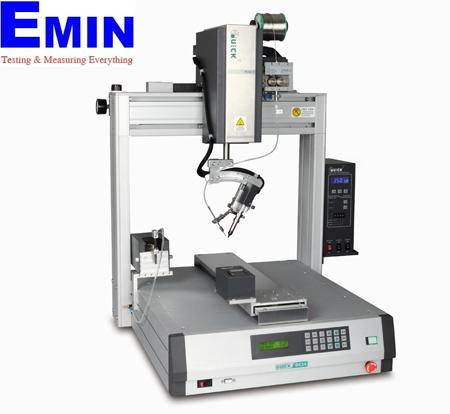
Where soldering robots fit in electronics manufacturing
A robotic soldering system is typically used when the same soldering path must be repeated accurately over many cycles. Compared with hand soldering, automation makes it easier to keep temperature, dwell time, solder feed, and positioning within a controlled window. That matters in applications where joint consistency directly affects electrical reliability and product quality.
These solutions are often used for through-hole soldering tasks, wire-to-terminal work, connectors, shields, and selected electronic subassemblies that benefit from fixed process settings. For companies that still combine manual and automated workstations, it can also be useful to review related equipment such as soldering stations for prototype, repair, or low-volume operations.
Core elements of an automated soldering system
Most systems in this category combine several functional modules: a motion platform or robot arm, a temperature control unit, a solder wire feeder, a soldering head, and a tip cleaning mechanism. Together, these components allow the machine to repeat a defined soldering program while keeping the tip condition and solder feed stable across multiple joints.
Some configurations are supplied as integrated robot-ready soldering sets, while others are offered as complete bench-style robotic platforms. In practical production planning, the difference matters: a compact soldering kit may suit an existing automation cell, while a larger standalone robot may be the better choice for a dedicated soldering station with programmed paths and repeatability requirements.
Examples available in this category
Several solutions from JBC illustrate the robot-ready approach. Models such as the HM245-5A General Soldering Set for Robot and HM470-5A Heavy Duty Soldering Set for Robot are designed around controlled temperature operation, solder feeding, and dedicated robot interfaces. The HA245A-5B and HA470A-5B variants add automatic cartridge exchange capability, which can be relevant when uptime and tip management are important in repetitive production.
For users looking at full robotic soldering platforms, EVERPRECISION offers examples such as the EP2300-SR, EP2400-SR, and EP2500-SR for single-station work, along with twin-station or twin-head formats such as the EP1602-SR, EP2502-SR, EP2702-SR, and EP1400-SRII. The EP200-SK Automated Soldering Kit represents another option for integrating soldering process modules into a broader automation setup.
Within these examples, the practical differences usually relate to working envelope, station layout, heating power, feeder range, cleaning method, and how the program is taught or transferred. Rather than focusing only on a single specification, buyers should assess how the full system matches the target product, takt time, and required joint geometry.
How to choose the right soldering robot
The first step is to define the soldering task clearly. Joint type, pad size, wire diameter, access angle, heat demand, and required throughput all influence the machine configuration. A compact robot may be enough for smaller assemblies, while larger boards or dual-workstation production can call for wider travel ranges or twin-station designs.
It is also important to evaluate the thermal profile of the process. Some jobs require more heating capacity for heavier connectors, larger terminals, or joints with greater thermal mass. In the products shown here, available temperature ranges and power classes differ between models, so matching the heat capability to the application is more useful than simply choosing the highest value.
Programming method and maintenance workflow should not be overlooked. Teach pendant operation, point capacity, storage for multiple programs, tip cleaning, and feeder control all affect real-world usability on the production floor. If the line also includes rework or repair steps, related process equipment such as hot air and SMT rework systems may be part of the broader tooling strategy.
Single-station, twin-station, and heavy-duty configurations
Not every production line needs the same robotic layout. Single-station soldering robots are often selected for straightforward part handling and moderate throughput, especially when one fixture and one soldering path are enough for the process. These systems can be a practical fit for small to mid-sized electronic assemblies where floor space and programming simplicity matter.
Twin-station designs are useful when one side can be loaded or unloaded while the other side is processing, helping reduce idle time around the soldering cycle. Twin-head systems can support higher output or more flexible process coverage, depending on the fixture concept and production sequence. Heavy-duty soldering sets, meanwhile, are better aligned with applications that require higher thermal capacity and more demanding heat transfer.
Process stability, ESD awareness, and production consistency
In electronics manufacturing, successful automation is not only about movement accuracy. Stable soldering also depends on controlled temperature, repeatable wire feed, clean tip condition, and suitable contact time at the joint. Robot-ready soldering sets that are designed for ESD-sensitive environments can support cleaner integration into electronics assembly lines where component protection is part of the quality plan.
Repeatability is especially valuable when documenting process windows or standardizing production across shifts. A robotic platform can help reduce variation introduced by operator technique, but overall results still depend on proper fixturing, suitable tip selection, solder material choice, and validation on the actual product. For post-solder correction or component removal workflows, some manufacturers also pair these systems with desoldering stations in the same process area.
Who typically buys from this category
This category is relevant for OEMs, EMS providers, electronics assembly contractors, and industrial manufacturers that need a more controlled soldering process. Common buyers include process engineers, automation engineers, production supervisors, and purchasing teams evaluating equipment for new lines or upgrades to existing cells.
Selection often depends on whether the project is aimed at pilot production, medium-volume manufacturing, or a dedicated repetitive process. In many cases, the right choice is the one that balances motion range, heating capability, feeder compatibility, and programming convenience with the actual product mix on the line.
Find a soldering robot that matches your process
The products in this category cover different levels of automation, from robot-integrated soldering sets to complete programmable soldering robots with single or twin-station layouts. That makes it easier to compare options based on application needs rather than forcing one format into every workflow.
If you are selecting equipment for electronics assembly, focus on the real process variables: joint type, access, cycle time, thermal demand, and integration method. A well-matched soldering robot can improve consistency, support production scaling, and reduce variation in repetitive soldering tasks without overcomplicating the line.
-
-
-
-
-
-
-
-
-
-
-
-
-
-
-
-
-
-
-
-
-
-
-
-