


Leeb and Handheld Hardness meter
When hardness needs to be checked directly on large parts, installed machinery, weld zones, castings, or heat-treated components, a bench-top instrument is not always practical. In these situations, Leeb and handheld hardness meters offer a fast and portable way to evaluate material condition without moving the workpiece to a lab.
This category is focused on portable rebound-type instruments used for on-site metal hardness testing. They are commonly selected in maintenance, incoming inspection, fabrication, machining, and field service work where mobility, quick setup, and support for multiple hardness scales are important.
Why Leeb hardness testing is widely used in the field
The Leeb method measures hardness based on the rebound behavior of an impact body striking the test surface. In practical terms, this makes it well suited for portable testing on metallic parts where users need immediate readings and convenient conversion into scales such as HL, HRC, HB, HV, or HS, depending on the instrument and material group.
Compared with fixed systems, handheld units are easier to carry between production areas, warehouses, maintenance sites, and customer locations. They are especially useful for larger components that are difficult to cut, transport, or position under a conventional hardness tester.
Typical applications for handheld hardness meters
Portable hardness testers are commonly used to check forged parts, steel structures, cast components, pipes, pressure parts, shafts, molds, and machined surfaces. They are also useful for comparing hardness across different points on a part, which can help identify variation after heat treatment, welding, or surface processing.
In maintenance and asset inspection, handheld devices support quick condition checks without major disassembly. For users who also compare portable rebound testing with other methods, it can be helpful to review ultrasonic hardness tester options for applications involving thinner sections or more localized measurements.
What to consider when selecting a portable hardness tester
The first point is the material and hardness scale you need to work with. Products in this category may support common conversions across Rockwell, Brinell, Vickers, Shore, and Leeb scales, but the usable range still depends on material type and instrument design. Steel, cast steel, alloy steel, stainless steel, cast iron, aluminum alloys, brass, bronze, and copper alloys are often covered, but buyers should always confirm compatibility at product level.
The second point is workpiece condition. Surface finish, minimum thickness, part mass, and test location all affect whether Leeb testing is suitable. Some devices are intended for stable, heavier workpieces, while others can be used on smaller parts with proper coupling methods and support conditions.
A third factor is data handling. If inspection records need to be saved or transferred, features such as internal memory, USB connectivity, or software support become important. In quality control environments, buyers also often look for versions supplied with calibration documentation or compatibility with a standard hardness test block for routine verification.
Examples of instruments available in this category
This range includes compact and advanced portable units from manufacturers such as PROCEQ, PCE, MOORE & WRIGHT, and NOVOTEST. Different models are designed around slightly different priorities, such as compact dimensions, broader data storage, rechargeable or battery-powered operation, or support for multiple materials and converted hardness scales.
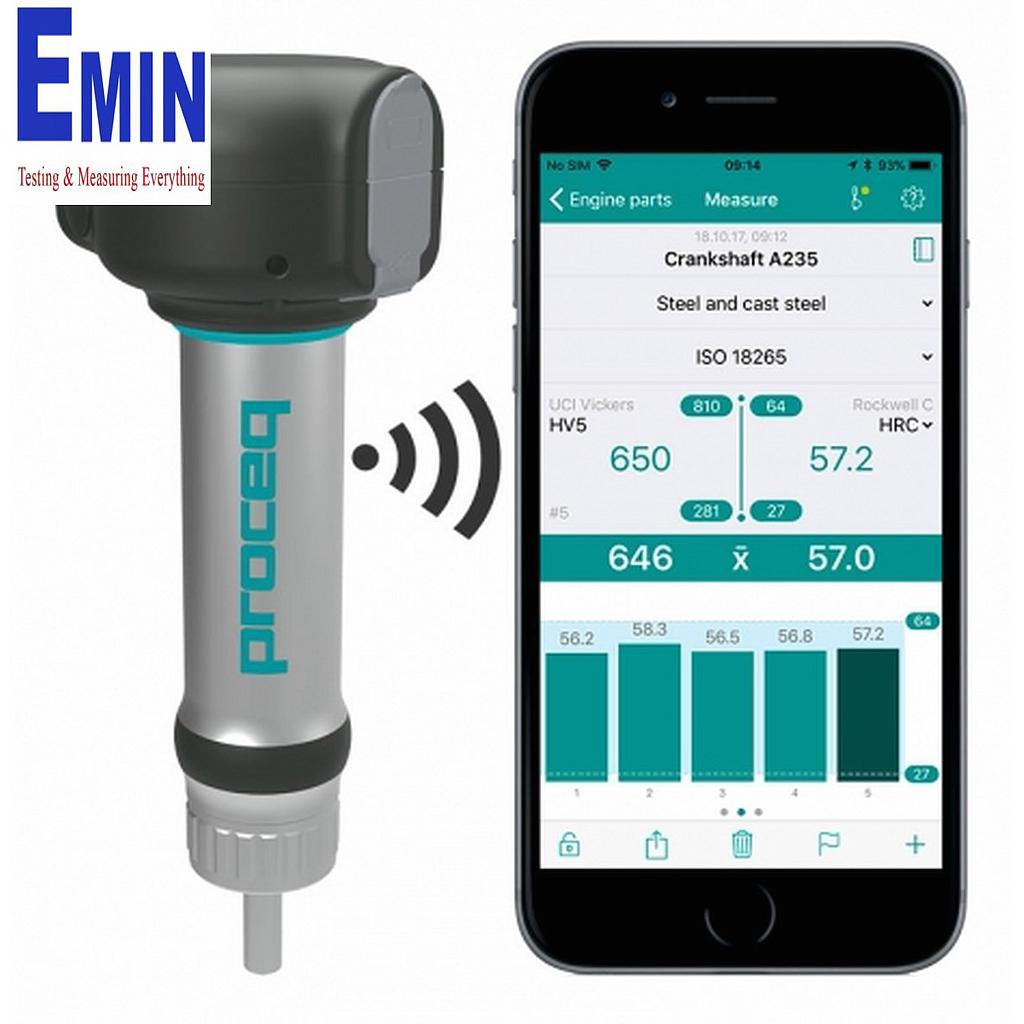
For example, the PROCEQ Equotip Live leeb D is aimed at portable Leeb testing with a defined measuring range and multi-scale conversion. The NOVOTEST T-D2 and T-D2-R models are suitable for users who need a compact field instrument with common hardness scale support, while the MOORE & WRIGHT MWT-3100 and several PCE handheld testers illustrate options for portable metal inspection with 360-degree measurement orientation, onboard display, and stored readings.
How handheld Leeb testers differ from bench-top hardness systems
A portable Leeb tester is designed for speed and accessibility rather than for every possible test scenario. It is often the right choice when the part is large, already installed, or needs to be inspected in multiple locations across a plant or site. This makes handheld units highly practical for production support, maintenance, and incoming goods inspection.
However, laboratory and production-line quality systems may require a more controlled testing method. Where standardized indentation methods and fixed test loads are preferred, users may also consider a Rockwell hardness tester or a universal hardness tester depending on material type, reporting needs, and sample preparation.
Key practical checkpoints before testing
Reliable results depend not only on the instrument but also on test conditions. The surface should be sufficiently prepared for rebound measurement, and the part should meet the minimum stability and thickness requirements stated on the product page. Irregular geometry, rough surfaces, or very light workpieces can influence readings if not properly managed.
It is also good practice to verify performance using a reference block before critical measurements. Many buyers in industrial QA and maintenance keep portable testers together with accessories such as support rings, cleaning tools, software, USB interfaces, and comparison or calibration blocks to maintain repeatable inspection routines.
Choosing the right fit for your inspection workflow
If your priority is everyday portability, a lightweight handheld unit may be the most efficient choice. If you need broader storage capacity, calibration documentation, or more extensive material and scale handling, a higher-spec model may be more suitable. The best option usually depends on whether the instrument will be used for quick screening, maintenance trending, incoming inspection, or more formal quality records.
This category brings together portable solutions for users who need hardness testing closer to the point of production or service. By matching the tester to the workpiece size, material group, surface condition, and reporting needs, it becomes easier to choose a handheld system that supports practical and repeatable field inspection.
-
-
-
-
-
-
-
-
-
-
-
-
-
-
-
-
-
-
-
-
-
-
-
-