


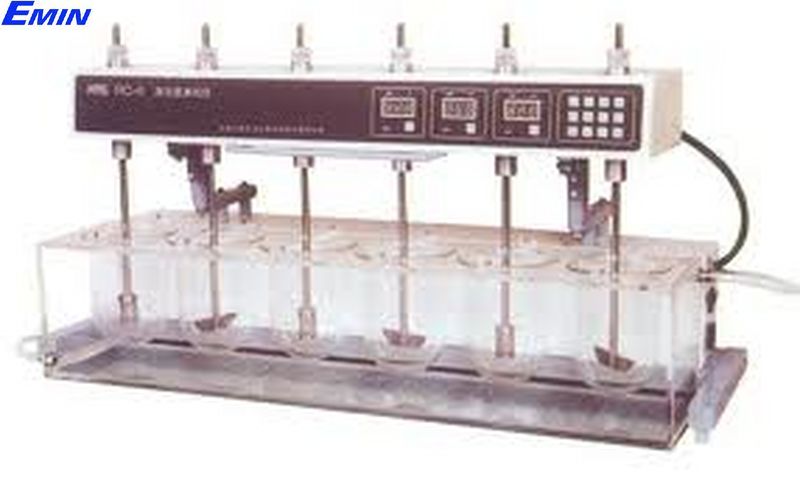
Máy đo độ hoà tan thuốc
Reliable dissolution data is essential when tablet and capsule performance must be verified under controlled laboratory conditions. In pharmaceutical QC, formulation development, and routine release testing, a tablet dissolution tester helps evaluate how an active ingredient is released into a defined medium over time, supporting consistent product quality and method compliance.
This category brings together instruments used for dissolution testing in pharmaceutical laboratories, with configurations suited to different throughput and workflow needs. Whether you are building a new QC setup or replacing older equipment, the focus should be on control stability, vessel configuration, sampling flexibility, and day-to-day usability.
Where dissolution testers fit in pharmaceutical testing
Dissolution testing is a core part of assessing oral solid dosage forms. By monitoring the release profile of a product in a controlled bath with defined agitation, laboratories can compare batch consistency, support formulation studies, and generate data required for quality documentation.
In practice, this equipment is often used alongside other pharmaceutical test instruments that evaluate mechanical and physical tablet properties. For example, labs may also review tablet disintegration testing equipment or a medicine hardness tester when building a broader oral dosage form testing workflow.
Key features to consider when choosing a dissolution tester
The most important selection criteria usually start with speed control, temperature stability, and the number of test positions. Stable rotation and accurate bath temperature are critical because even small deviations can affect dissolution profiles and repeatability across runs.
Users should also review how the system handles timing, sampling intervals, and method storage. In laboratories running multiple products or frequent routine methods, programmable test steps and data retention can simplify operation and reduce the risk of manual setup errors.
Another practical point is the vessel and shaft arrangement. A 6-station system may be sufficient for many labs, while higher-capacity configurations can improve efficiency where sample loads are larger or where parallel comparisons are common.
Typical system configurations in this category
Several instruments in this category illustrate the range of available setups. The Bonnin RCZ-6N tablet dissolution tester is suited to laboratories looking for a 6-vessel platform with controlled speed and temperature performance for routine testing. For users requiring a similar operating concept but more positions, the Bonnin RCZ-8N provides an 8-vessel configuration that can better support higher sample throughput.
For laboratories that need a more system-oriented platform, the PG instruments DS 14000 Dissolution System offers broader control and programming functions. Based on the available product information, it is designed for lab and QC environments where programmable intervals, stored methods, and reporting support are important parts of the workflow.
These examples show that capacity is only one part of the decision. The right choice also depends on how the lab manages routine methods, operator interaction, and documentation requirements.
Operational factors that affect test consistency
A good dissolution setup is not defined only by headline specifications. Day-to-day reliability depends on how well the instrument maintains temperature uniformity, rotational accuracy, and mechanical alignment of paddles or baskets during repeated use.
Labs should pay attention to the consistency of shaft motion, the stability of the water bath, and the resolution of control settings. Instruments in this category include models with fine temperature resolution and controlled RPM adjustment, which helps support repeatable method execution when procedures require strict operating windows.
Sampling workflow also matters. Systems that support timed or programmable sampling can be useful when test methods involve multiple collection points across a dissolution profile. In busy environments, this can improve traceability and reduce manual intervention during long test runs.
How to match the instrument to your lab workflow
For small to mid-volume QC labs, a standard multi-position dissolution tester with straightforward controls may be the most practical choice. It can cover routine release testing without adding unnecessary system complexity. In these cases, selecting between 6 and 8 vessels often comes down to expected batch volume and scheduling efficiency.
For development labs or facilities that run more varied methods, a system with programmable parameters, stored methods, and reporting options may provide better long-term value. If your workflow also includes complementary tablet evaluations, it may be useful to review related tools such as a medicine friability tester for abrasion resistance checks or a medicine melting meter where thermal behavior testing is relevant.
In all cases, buyers should consider operator training level, expected test frequency, maintenance access, and how easily the instrument fits into existing SOP-driven laboratory practice.
Common use cases for dissolution testing equipment
This category is relevant for pharmaceutical manufacturers, contract laboratories, university research labs, and formulation teams working with tablets and capsules. Common applications include routine quality control, comparative release studies, method transfer support, and development-stage evaluation of oral solid dosage forms.
A dissolution tester can also support investigations when a product shows unexpected behavior during downstream quality checks. When results are reviewed together with hardness, friability, or disintegration data, laboratories gain a more complete understanding of dosage form performance rather than relying on a single test outcome.
Choosing with confidence
The best fit usually comes from balancing vessel capacity, control precision, programmability, and the practical needs of your laboratory. A simpler platform may be ideal for standardized QC routines, while a more advanced dissolution system can be a better match for method-heavy environments that require more flexible operation and reporting.
Within this category, options from Bonnin and PG instruments provide a useful starting point for comparing compact routine testers and more feature-rich dissolution systems. Reviewing your required test volume, operating procedures, and data handling expectations will make it easier to identify the right instrument for your pharmaceutical lab.
-
-
-
-
-
-
-
-
-
-
-
-
-
-
-
-
-
-
-
-
-
-
-
-