


Solar panel testers
Accurate field verification is essential when commissioning, troubleshooting, or maintaining photovoltaic systems. In practice, technicians often need more than a simple voltage check—they need a reliable way to evaluate string performance, insulation condition, continuity, irradiance, temperature, and in some cases I-V behavior under real operating conditions. That is where solar panel testers become especially useful for installers, service teams, and industrial maintenance professionals.
This category brings together instruments designed for PV testing tasks across installation, inspection, and performance analysis. Depending on the job, the right tool may help confirm open-circuit voltage and short-circuit current, detect insulation issues, verify protective conductor continuity, compare expected versus actual output, or support structured reporting for service documentation.
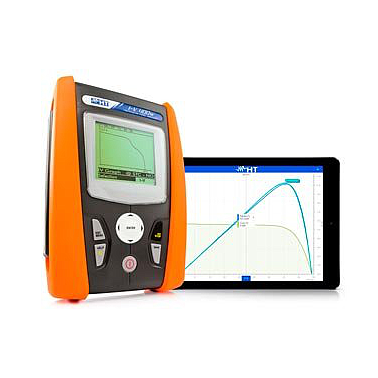
What these testers are used for in PV work
PV systems operate in environments where electrical safety, weather exposure, and performance variability all matter. A dedicated tester helps technicians assess the condition of modules and strings without relying only on general-purpose instruments. This is important during initial installation, periodic inspection, fault finding, and post-maintenance verification.
Many applications involve checking basic electrical values such as Voc and Isc, then moving into deeper tests such as insulation resistance, continuity, operating current, DC power, irradiance, and panel temperature. In larger or more demanding service workflows, test teams may also use instruments that support I-V curve tracing to understand how a module or string behaves under load rather than from static measurements alone.
Common measurement functions in this category
The scope of a solar panel tester can vary from a compact troubleshooting tool to a multifunction PV analyzer. Typical functions in this category include open-circuit voltage measurement, short-circuit current measurement, continuity checks for protective conductors, and insulation testing at different test voltages. These are core tasks for confirming both electrical integrity and safe operation.
Some models extend beyond basic installation checks. For example, the FLUKE SMFT-1000 kits combine PV electrical measurements with performance analysis and I-V curve tracing, while the Seaward PV200 Complete Kit supports solar installation testing with onboard memory and PC data transfer. Instruments such as the HT PV-ISOTEST are more focused on photovoltaic insulation testing and fault location workflows, which can be valuable when diagnosing string-level issues.
Where general troubleshooting is part of the job, users may also pair PV-specific instruments with supporting tools such as a digital multimeter for broader electrical checks outside the dedicated solar test sequence.
Examples of test solutions and accessories
Different field teams need different levels of capability. A multifunction kit can reduce setup time by combining several steps into one workflow. The FLUKE FLK-SMFT-1000/PRO and FLK-SMFT-1000/KIT are examples of integrated PV test solutions that support voltage, current, insulation, continuity, and power-related checks, with software support available for reporting and data handling.
For troubleshooting and portable survey work, FLIR offers kit-based approaches such as the FLIR PV-KIT-1 and PV-KIT-2, which combine clamp measurement, irradiance and temperature tools, and in the larger kit, a solar panel tester with I-V curve tracing. The FLIR PV48 is aimed at panel-level electrical characterization, while accessories in this category such as the HT SOLAR02 remote unit, HT PT305 PT1000 probe, and HT KITGSC4 cable kit support measurement setup and environmental correlation rather than replacing the main tester itself.
Software and accessories can also matter in daily work. For example, data handling tools such as FLUKE TruTest Lite Data Management and Reporting Software can support more structured documentation, especially where test records are part of handover or maintenance reporting.
How to choose the right solar panel tester
The best choice depends on the stage of the PV lifecycle and the level of diagnosis required. For installation and commissioning, it is often useful to prioritize instruments that cover continuity, insulation resistance, Voc, and Isc in one device. This helps reduce the number of separate tools needed on site and supports a more consistent testing procedure.
For troubleshooting and performance assessment, it may be worth considering tools that include I-V curve tracing, irradiance input, temperature measurement, and current clamp compatibility. These functions help technicians compare measured behavior with expected performance under actual field conditions. If your work frequently involves locating string faults, a model with dedicated fault-location capability can be more suitable than a general PV meter alone.
Measurement range is another practical factor. In this category, some products are suited to systems up to 1000 V DC, while others extend to 1500 V environments. Current range, portability, data logging, software compatibility, and included leads or probes can all affect field efficiency just as much as the headline electrical specifications.
Why environmental measurements matter
Electrical results from a solar array only tell part of the story. Irradiance, module temperature, and panel tilt influence expected output, so the ability to capture these conditions can improve the value of a test report. That is why some kits include irradiance meters, temperature probes, or remote recording units alongside the main tester.
When comparing strings or investigating underperformance, correlated environmental data helps distinguish between a genuine electrical fault and normal variation caused by sunlight or heat. Tools such as the HT SOLAR02 and PT1000 probe, or integrated kits from FLIR and FLUKE, support this more complete assessment approach.
Solar testing and fault diagnosis
In the field, faults may not present as a complete outage. Instead, technicians may see reduced output, unstable insulation results, mismatch between strings, or intermittent grounding issues. A dedicated PV tester helps narrow down whether the problem relates to module behavior, cabling, continuity, insulation, or operating conditions.
For some maintenance teams, fault finding overlaps with broader electrical diagnostics. If the application requires tracing or isolating grounding-related issues, related categories such as ground fault location instruments and earth resistance testers may also be relevant depending on the site and test procedure.
Brands commonly selected for PV measurement
This category includes instruments from manufacturers widely used in electrical testing and industrial maintenance. FLIR, FLUKE, Seaward, and HT are particularly visible in the current product mix for solar testing tasks, ranging from compact troubleshooting kits to multifunction analyzers and PV insulation testers.
Each brand may suit a different workflow. Some users prioritize integrated reporting and commissioning features, while others focus on insulation testing, environmental measurement, or portable field troubleshooting. The most effective approach is to match the instrument to the actual service routine, site voltage level, and documentation requirements rather than selecting by brand name alone.
Finding the right fit for your testing workflow
Choosing among solar panel testers is easier when the decision starts with the real task: installation verification, preventive maintenance, troubleshooting, or performance analysis. From compact panel testers to multifunction PV analyzers and supporting accessories, this category is intended to help professionals build a testing setup that matches the complexity of the job.
If you are comparing tools, focus on the measurements you need most often, the system voltage range, and whether you need environmental correlation or reporting support. A well-matched tester can streamline field work, improve diagnostic confidence, and make solar inspection results more consistent across projects.
-
-
-
-
-
-
-
-
-
-
-
-
-
-
-
-
-
-
-
-
-
-
-
-